

“Co-op is canceled tomorrow? They never cancel co-op.” Incredulous, I passed the salt to the other end of the dinner table.
“It’s because of the hurricane. It’s supposed to come all the way up here.” My son replied, taking the salt.
“Huh. Perhaps I should make a pot of soup?” I asked it as a question to my husband.
“We should charge our cell phones.” He replied.
That night, the evening of September 26, 2024, we looked at the local weather channel—something we literally never do. We had heard of this devastating hurricane called Helene, but being 420 miles inland from where it made landfall, we hadn’t been concerned. But Helene, after causing a deadly storm surge in Big Bend, Florida, also seemed unconcerned as she ate her way through Georgia, tornadoes spinning from her arms.
There are some things you can never be prepared for, even if you know it’s coming. And who, being held in the soft blue arms of the Appalachian Mountains, prepares for…a hurricane? Yet Helene came at last to a rural mountainous spot of Western North Carolina and there, for reasons we can’t explain, she stopped—emptying herself of all she had left.
There had been heavy rainfall in the days before and the saturated ground could hold no more. A staggering 20-30 inches of rain fell within three days as the heavens opened. Creeks—already swollen—turned to raging rivers, and rivers turned into forces that lifted whole houses from their foundations, claiming lives.
Spiraling winds and gusts measured at over 100 mph lay whole mountainsides of trees flat, smashing homes and locking people in place while flash floods whipped away roads and caused mountain-melting landslides.
Our home, 50-60 miles south of the peak devastation, was unharmed. Unable to receive news and focused on our own needs, we were slow to learn what had happened just north of us.
Rain turned our gutters into raging creeks and our yard into a river. Over the din of the storm you could feel the cracking thuds of trees going down in our woods. Our neighbor had urged us many times in the last year to take his generator, but we left it in the event that he might need it. The Lord took him home the week before the storm and with dangerous winds still whipping around us, my husband and son went to retrieve it from his now empty house. I, ever eager for adventure, wanted to see how long we could go without power, until it dawned on me that my husband’s mobility completely relied on his being able to charge his wheelchair, and so the gas fuming cacophony was appreciated.
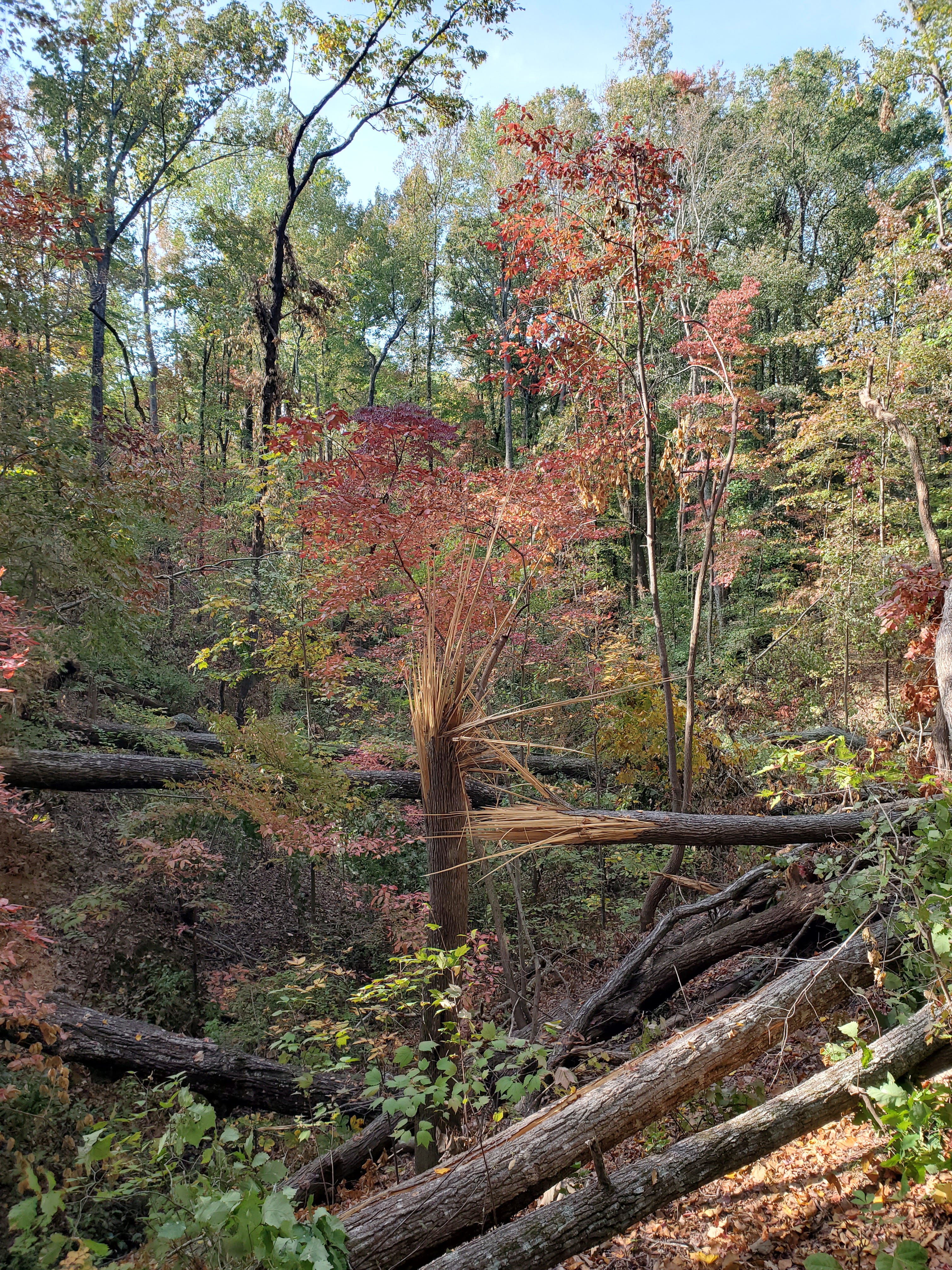
The woods behind our house after Helene
When the winds were no longer dangerous, my daughter and I went to inspect a place where a number of large oaks had fallen. There we found a bedraggled flying squirrel. His buggy-eyed cuteness was a welcomed joy amidst destruction. Gathering his frightened, soaked self into a box, we took him home to nurse him on sunflower seeds and raisins.
Neighbors with chainsaws cleared a narrow one-way road out for us, and Michael was able to join a near 100-car line at the gas station, hoping to get enough to keep our generator going. The National Guard came a few days later to clear the more dangerous trees that had made a slingshot of our power lines blocking another road.
I don’t remember when the helicopters started, but living under one of the major airways, their engines filled the would-be silence of a powerless existence. The Black Hawks and Chinooks as well as a good handful of private aircraft cut a near constant path northward through the sky, bringing emergency supplies and performing rescue missions for our neighbors in the north. And we began to hear stories—and numbers.
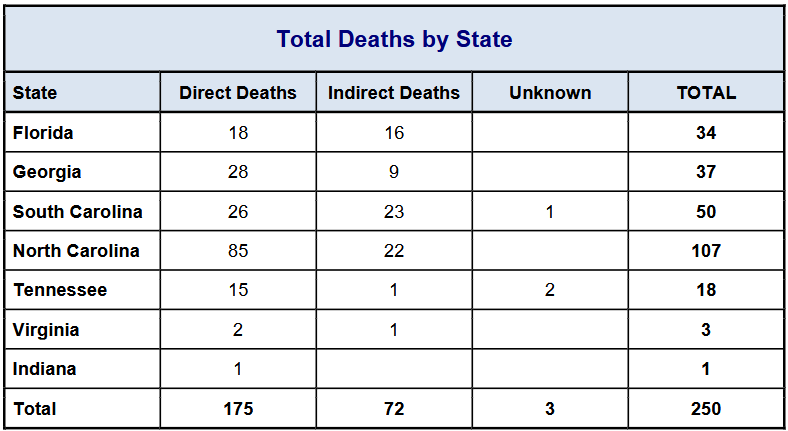
Taken from the National Hurricane Center Tropical Cyclone Report, Helene, pg 18
Michael (my husband), hearing of the relief work Samaritan’s Purse was doing, gathered a group of 28 staff and students from the Bible college and went to join. Hedging, wondering if a man in a wheelchair could be of any use in a disaster zone, he at last concluded that he could at the very least be the bringer of people. Driving up there was a surreal experience of seeing devastation usually only seen in the pictures of places far from our own existence.
The team was assigned work on a house owned by a man—a man in a wheelchair. Sitting wheel to wheel, the man told Michael the story of how the fire department had come to get him but he had refused to leave his home.
“I survived Vietnam! I can survive this!” he’d said. He had sat on his bed as the water rose up to his mattress.
The man really wanted a pot for coffee. A camp stove had been supplied, but all his pots were contaminated (clean water would not be restored for over 50 days in some places). He wanted a pot or, perhaps, a percolator? Michael set out to one of the piles of donated supplies dotting the roadside. A person guarding the pile to prevent looting helped Michael look and a percolator, still in its box, was unearthed. The man kept it boiling continuously throughout the day. More than drink, he really just wanted something warm to hold.
A week or so later our oldest son went with another group, this time from our church, to serve with Samaritan’s Purse. Their vehicle pulled into a large area swept clean of everything—at its edge was the Swannanoa River. He was told that the area had had over 100 trailer homes on it before the river surged and took every one of them away. Our son looked downstream and saw the mangled remains of trailer homes hung high in the oak and sycamore trees lining the river—and there were tears of grief at the sheer destruction.
He joined a crew sludging out the basement of a brick home that had withstood the flood. Mold and rotting animal bodies among other things made Hazmat suits a necessity. The home was owned by an older woman who related how her pastor had visited her the night before the storm.
“I think you need to come spend the night at my place.” he had said. She went with him and that night the flood came through. Water rose 20 feet into her home. Had she stayed, she would not have survived.
We heard stories of homesteads that had been farmed for generations being wiped away. We heard of people letting loose their animals and fleeing for their lives. We heard of survivors being trapped and their situations becoming desperate as the remote and undulating valleys kept them hidden from rescue helicopters. Countless businesses, several schools, and the Unicoi hospital were flooded.
Strong the wind, strong the gushing,
Of the water, rushing, rushing,
Flooded homes, flooded minds,
Splintered trees, lie in lines.
Broken fences, broken hearts,
Lives and land, now in parts.
Swept and rutted, dreams of years,
What held hopes, now holds tears.
Strong we were, now we see,
How dependent man can be,
God who knows, God who sees,
God who holds, God who grieves,
Lifted hands, You we lean,
In the wake, of Helene.
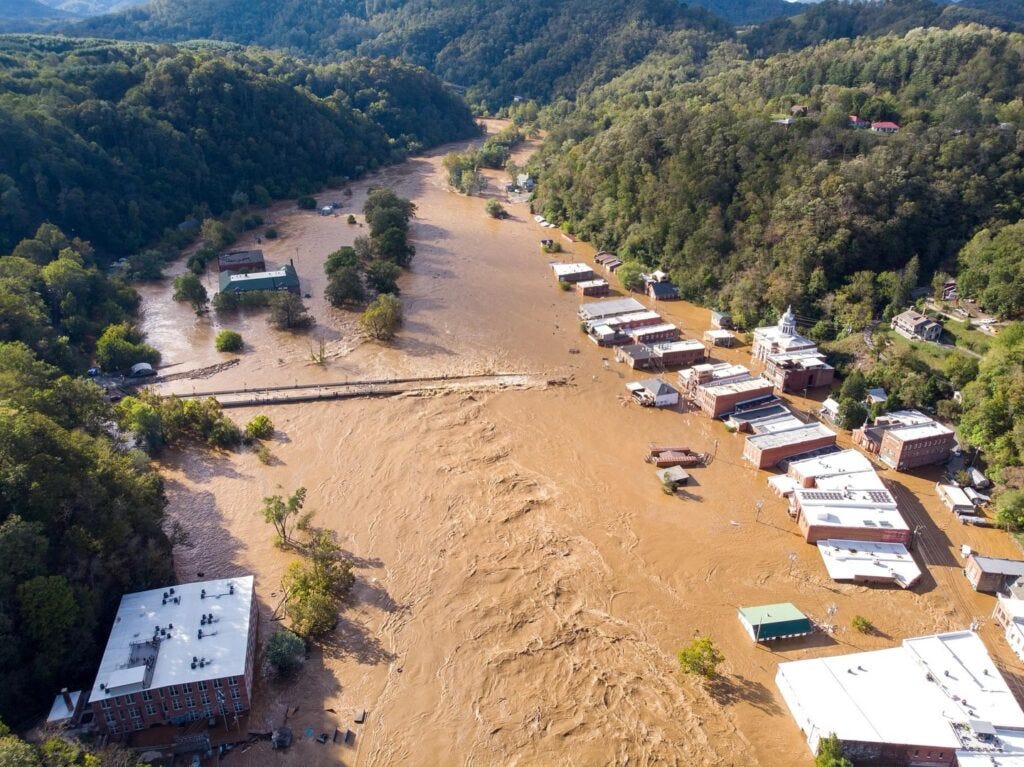
Photo courtesy Old Marshall Jail Hotel
Yet filtering in through the stories of loss, as light filtering through thick leaves, were also incredible, even, unbelievable stories of rescue and provision. Among those stories were accounts of how people who would never have otherwise come, poured into churches knowing that they would find refuge and help and they were introduced to The Refuge and Help (Psalm 46:1). We don’t pretend to know all of the why. No answers answer the heart-wrenching losses of Helene. But God is kind to let us see glimmers of the redemption that we know he is still working.
For those of you still grieving: I am so, so sorry. May God comfort you.
God is our refuge and strength,
a very present help in trouble.
Therefore we will not fear though the earth give way,
though the mountains be moved into the heart of the sea,
though its waters roar and foam,
though the mountains tremble at its swelling. Selah
There is a river whose streams make glad the city of God,
the holy habitation of the Most High.
God is in the midst of her; she shall not be moved;
God will help her when morning dawns.
Psalm 46: 1-5
Please share this if you think it can encourage someone you know.
Thank you for reading Befriend Faithfulness! You can subscribe for free to receive more posts and support my work.
All facts about Hurricane Helene were gathered from https://www.nhc.noaa.gov/data/tcr/AL092024_Helene.pdf
Your writing is so beautiful. I’m far away from the devastation of Helene and did not experience any of it. But your words made me feel it and my heart joins with yours in prayer for those still suffering and grieving all the storm took.
Beautiful, Marie. I hope this reaches the people who experienced such devastation so that they may be pointed to Christ and comforted by your words. ❤️